
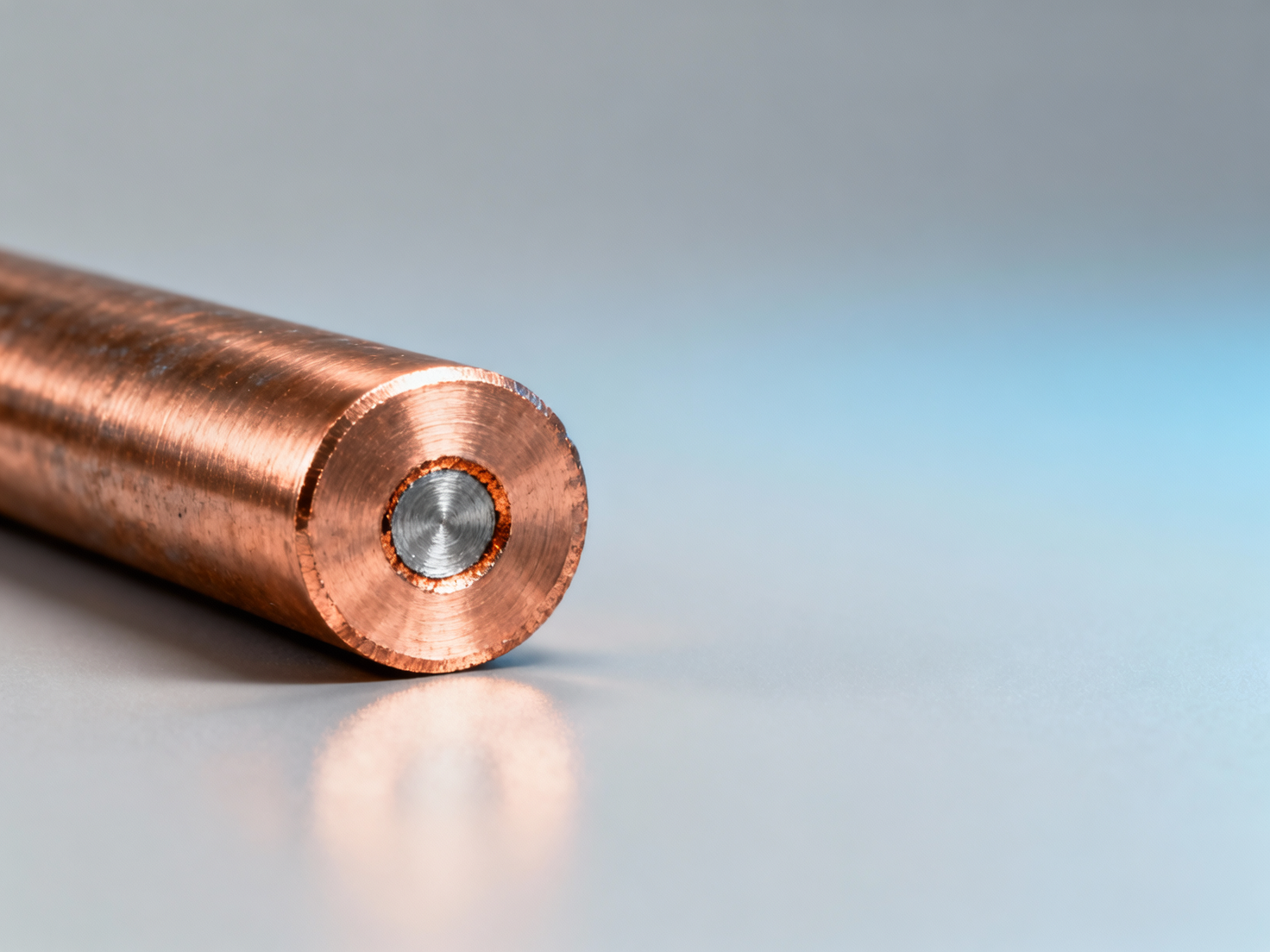
Before purchasing copper-clad steel for grounding systems, it’s critical to verify material composition, copper layer thickness, adhesion quality, corrosion resistance, and compliance with standards like ASTM B416 or UL 467. Since copper directly impacts conductivity, durability, and long-term safety, overlooking key specifications can compromise system performance and increase lifecycle costs. Whether you’re a procurement specialist evaluating suppliers, an engineer validating technical parameters, or a safety manager ensuring code compliance—this guide helps you systematically assess what truly matters in copper-clad steel selection.
Material Composition & Core Structural Integrity
Copper-clad steel (CCS) is not a surface-plated product—it’s a metallurgically bonded composite where a continuous copper layer is permanently fused to a high-strength steel core. The steel substrate typically accounts for 70–90% of the cross-sectional area and provides mechanical strength, tensile stability, and driving capability during ground rod installation. The copper cladding contributes conductivity and corrosion resistance. A typical CCS rod used in utility grounding has a steel core with minimum yield strength of 580 MPa and ultimate tensile strength ≥ 760 MPa.
Substandard CCS may use low-carbon or untempered steel cores that fracture under hammering or fail during soil expansion cycles. Equally concerning are products using recycled copper or non-electrolytic copper layers, which degrade conductivity and accelerate interfacial oxidation. ASTM B416 mandates a minimum copper purity of 99.9%, while UL 467 requires verification of both copper thickness and bond integrity—not just appearance.
Manufacturing method also affects performance: cold-drawn CCS offers superior dimensional consistency and uniform copper distribution versus hot-rolled alternatives. For applications requiring repeated bending (e.g., grounding conductors in substations), elongation at break must exceed 12%—a specification often omitted in supplier datasheets but critical for field reliability.
This table underscores why relying solely on “copper content by weight” is misleading. A 30% copper-by-weight rod may have uneven cladding or poor interfacial bonding—rendering its effective conductivity less than a 20% rod with uniform, metallurgically sound coverage. Always request certified mill test reports showing tensile curves, elongation data, and copper layer uniformity across full-length samples.
Copper Layer Thickness & Adhesion Verification
Copper thickness determines both current-carrying capacity and service life. Per ASTM B416, nominal thicknesses range from 0.004 in (0.10 mm) to 0.010 in (0.25 mm). However, the standard permits ±10% tolerance—meaning a “0.008 in” rod could legally be as thin as 0.0072 in. In aggressive soils (pH < 5.5 or resistivity < 20 Ω·m), such variance accelerates copper depletion. Field testing shows rods with ≤ 0.0065 in average copper thickness lose >40% of their effective cross-section within 8–12 years.
Adhesion is equally vital. Poor bonding leads to copper delamination during driving or thermal cycling—exposing bare steel to rapid galvanic corrosion. The peel test (ASTM B570) requires ≥ 4.5 lb/in force to separate copper from steel. Yet many suppliers skip this test or report only “pass/fail” without quantitative values. Request peel test results from three locations along the rod length—not just one sample point.
Also verify copper layer continuity: microsection analysis should show no voids, porosity, or oxide inclusions at the copper–steel interface. Suppliers offering third-party microstructure reports (e.g., SEM/EDS imaging) provide stronger evidence of manufacturing control than those citing only “visual inspection.”
Key Adhesion & Thickness Checks During Procurement
- Require certified thickness measurement per ASTM B499 (magnetic induction or eddy current), with min/max values reported for ≥ 5 points per meter
- Verify peel test results meet ASTM B570 ≥ 4.5 lb/in at ambient and elevated temperatures (60°C)
- Confirm copper layer is applied before final cold drawing—not post-drawing electroplating
- Reject products with copper thickness variation exceeding ±7% across a single rod
Corrosion Resistance & Environmental Suitability
Grounding systems operate underground for 25–40 years. Soil chemistry—including chloride concentration, moisture retention, redox potential, and stray DC currents—dictates corrosion rate. Copper-clad steel outperforms bare steel but underperforms solid copper in highly saline or anaerobic environments. ASTM G187 defines accelerated corrosion testing for CCS: 1,000-hour salt-spray exposure followed by immersion in synthetic soil solution (pH 4.5, 0.5% NaCl, 0.1% NH₄NO₃).
Products passing ASTM G187 retain ≥ 92% of original copper thickness after testing. In contrast, non-compliant rods show pitting depth > 0.03 mm and interfacial rust streaks. For coastal or industrial sites, specify CCS with ≥ 0.009 in copper thickness and confirm compliance with IEC 62561-2 for lightning protection grounding components.
Also consider galvanic compatibility: avoid direct contact between CCS and aluminum conductors or zinc-coated hardware unless insulated or separated by bimetallic washers. Uncontrolled galvanic couples can accelerate copper dissolution at connection points—reducing effective grounding path life by up to 60%.
Note: These service life estimates assume proper installation (no bending beyond 3× diameter), verified exothermic welding, and absence of stray DC interference. Real-world degradation increases exponentially when any factor deviates from design assumptions.
Standards Compliance & Traceability Documentation
Compliance isn’t about checking a box—it’s about traceability. A compliant CCS product must carry lot-specific documentation including heat number, rolling date, copper thickness profile, peel test results, and certificate of conformance signed by a qualified metallurgist. UL 467 requires traceability back to raw material melt batches. Without this, you cannot validate root cause if field failures occur.
Beware of “self-declared compliance” without third-party validation. Reputable suppliers engage independent labs (e.g., Intertek, SGS, or UL) for periodic surveillance testing—at least quarterly. Ask for the latest lab report ID and verify its authenticity online. Also check whether the supplier maintains ISO 9001:2015 certification with scope explicitly covering “copper-clad steel for grounding applications.”
Finally, ensure packaging includes legible, permanent markings: nominal size, copper thickness, ASTM/UL designation, manufacturer logo, and production lot. Faded ink, adhesive labels, or missing lot codes indicate inadequate quality control—raising red flags for long-term accountability.
Procurement Best Practices & Supplier Evaluation Criteria
Procurement decisions should weigh six objective criteria: (1) documented adherence to ASTM B416 *and* UL 467, (2) availability of full mill test reports per lot, (3) minimum 5-year warranty covering both material defects and corrosion performance, (4) on-site technical support for installation validation, (5) lead time ≤ 4 weeks for standard sizes, and (6) flexibility for custom lengths (e.g., 10 ft, 12 ft, 14 ft) without MOQ penalties.
Engage suppliers early in design phase—not just at purchase order stage. Request sample rods for destructive testing (peel, microsection, tensile). Evaluate responsiveness: do they provide engineering data within 48 business hours? Can they explain how their cold-drawing process improves copper uniformity over competitors’ methods?
For enterprise buyers, consolidate specifications across projects into a master grounding materials standard. This reduces vendor fragmentation, enables bulk pricing, and ensures consistent performance across facilities—cutting long-term maintenance labor by up to 30% through predictable failure modes and spare-part interoperability.
Critical Questions to Ask Before Finalizing Purchase
- Can you provide peel test data for the exact lot I’m ordering—not just a generic report?
- What is your copper thickness measurement frequency per production shift, and what is the max allowable deviation?
- Do you offer joint inspection at your facility prior to shipment?
- How do you handle non-conforming material discovered during field installation?
- Is your CCS approved for direct burial in Class I, Division 2 hazardous locations per NEC Article 501?
Selecting copper-clad steel demands more than price comparison. It requires verifying metallurgical integrity, environmental resilience, and supplier accountability—all of which define system safety, regulatory compliance, and total cost of ownership. When every grounding conductor carries fault current that could endanger lives or disrupt critical infrastructure, due diligence isn’t optional—it’s foundational.
To ensure your next grounding system meets rigorous technical, safety, and longevity requirements, request a customized technical review and full compliance dossier for your specific application. Contact our grounding materials engineering team today for specification alignment, sample testing coordination, and project-level support.
Get real-time quotes
Interested? Leave your contact details.