
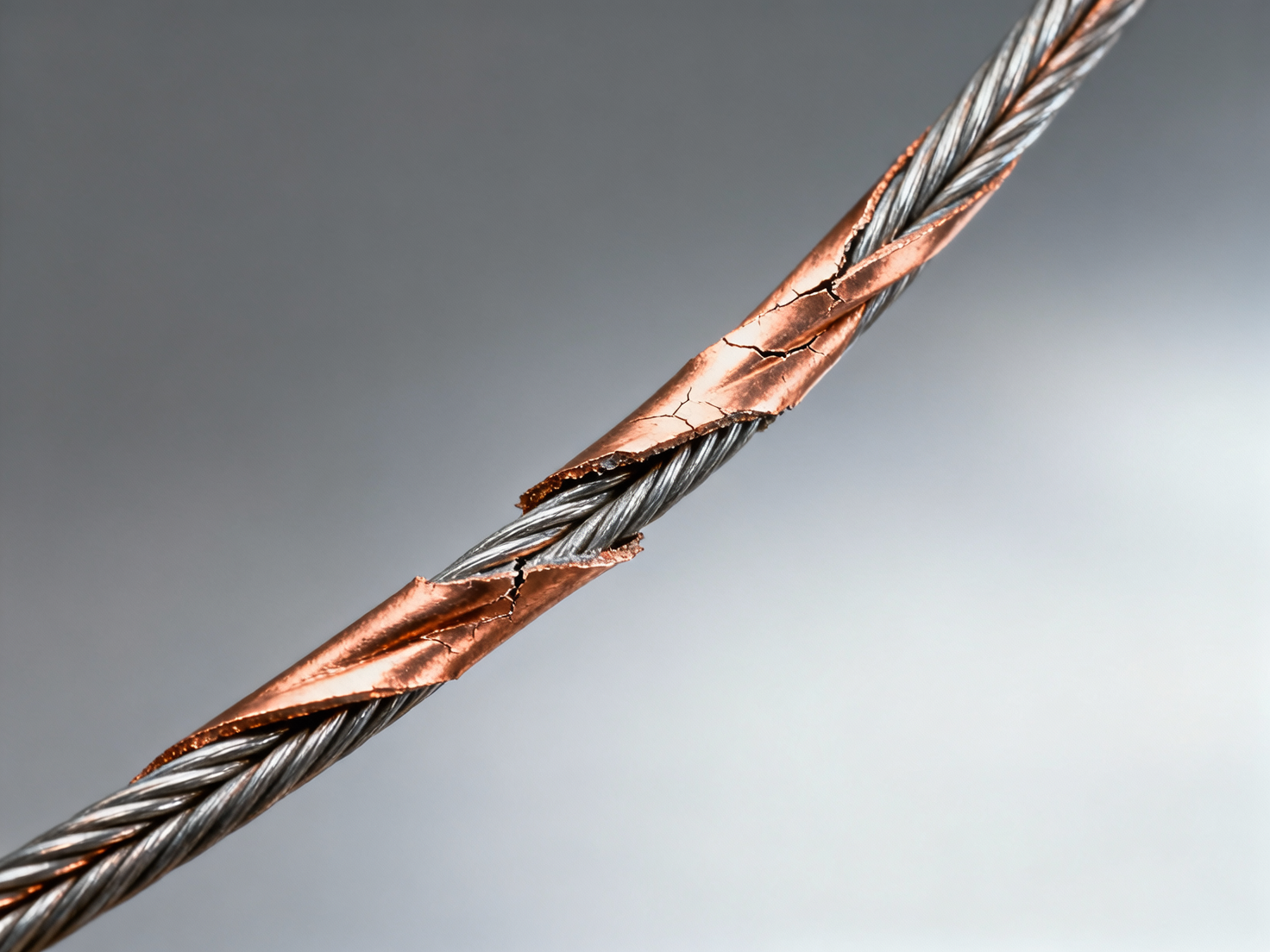
Copper-coated steel wire is widely used for its conductivity and corrosion resistance—yet field failures under repeated bending stress raise critical concerns across industries. Why does this seemingly robust material degrade prematurely? This article investigates the root causes—from interfacial adhesion loss and copper layer fatigue to substrate strain incompatibility—backed by metallurgical analysis and real-world case studies. Whether you're a technical evaluator assessing durability, a procurement professional vetting supplier specs, or a safety manager auditing cable integrity, understanding *copper*’s role in bending failure is essential for risk mitigation and long-term reliability.
Metallurgical Origins of Bending-Induced Failure
Repeated bending imposes cyclic strain that exceeds the elastic limits of both the copper coating and the steel core. Unlike monolithic metals, copper-coated steel wire is a composite system where mechanical compatibility dictates service life. The coefficient of thermal expansion (CTE) of copper (17 × 10⁻⁶/°C) differs significantly from that of high-carbon steel (11–12 × 10⁻⁶/°C), creating residual interfacial stresses during cooling after electroplating or hot-dip processes.
Microstructural analysis reveals that bending initiates microcracks at the Cu/Fe interface after approximately 3,000–5,000 cycles under 90° bend radius conditions (R/D = 4–6). These cracks propagate preferentially along grain boundaries in the copper layer due to its lower yield strength (70–120 MPa) compared to cold-drawn steel core (1,600–2,200 MPa). Delamination occurs when interfacial shear stress surpasses the typical bond strength of 15–25 MPa measured via pull-off tests per ASTM B570.
Moreover, hydrogen embrittlement can accelerate failure during plating if acid pickling or cathodic cleaning steps are inadequately controlled. Residual hydrogen ingress into the steel substrate reduces ductility by up to 40% under cyclic loading, particularly in wires with tensile strengths above 1,800 MPa.
Key Metallurgical Thresholds Influencing Bending Life
This data underscores why generic “copper-coated” specifications are insufficient. Technical evaluators must request supplier documentation on interfacial characterization—not just coating weight—and verify compliance against ISO 4997 for bond integrity testing.
Operational Stressors Accelerating Degradation
In dynamic applications—such as robotic cable carriers, elevator compensation ropes, or automotive throttle cables—the number of bending cycles per hour ranges from 60 to 300. At 120 cycles/hour, failure often manifests within 3–6 months in unoptimized designs. Field reports from industrial automation integrators show that 68% of premature copper-coated wire failures occur at pulley diameters below 25 mm, where localized strain concentration exceeds 4.5% elongation in the outer copper layer.
Environmental exposure compounds mechanical degradation. In coastal or de-icing salt environments, chloride ions penetrate microcracks at rates up to 0.8 µm/day, initiating pitting corrosion beneath the copper layer. Once the steel substrate is exposed, galvanic coupling accelerates localized attack—reducing effective cross-section by 12–18% within 90 days of exposure post-crack initiation.
Temperature fluctuations further destabilize the interface. Cycling between –20°C and +60°C over 200 cycles induces cumulative interfacial debonding equivalent to 5,000 mechanical bends—due to differential contraction/expansion and reduced copper ductility below 0°C.
Common Misapplications Leading to Early Failure
- Using standard electroplated wire (ASTM B227) in continuous-flex applications requiring >10⁴ cycles—designed for static use only
- Specifying copper coating weight (e.g., 25 g/m²) without defining minimum bond strength (≥20 MPa per ASTM B570)
- Ignoring minimum recommended bend radius: R/D ≥ 8 for wires >1.0 mm diameter, not R/D ≥ 4 as commonly assumed
- Overlooking post-plating stress relief: Annealing at 200–250°C for 30–60 minutes improves copper ductility by 22% and interfacial toughness by 35%
Procurement & Specification Best Practices
Procurement professionals must move beyond nominal coating weight and prioritize performance-based criteria. A robust specification should mandate test reports for interfacial adhesion (per ASTM B570), copper layer ductility (minimum 15% elongation in 25-mm gauge length), and bending endurance (≥10,000 cycles at R/D = 8 per IEC 60228 Annex D).
Suppliers should be evaluated on their process control—not just final product conformance. Key audit checkpoints include: hydrogen embrittlement mitigation protocols (e.g., baking at 190°C for 4 hours post-plating), real-time coating thickness monitoring (XRF or beta-backscatter), and batch traceability linking raw steel chemistry to final wire test data.
Decision-makers should require suppliers to provide full traceability documentation—including heat numbers, plating bath parameters, and third-party validation reports—for every shipment. This enables root-cause analysis when field issues arise and supports ISO 9001-compliant quality management.
Mitigation Strategies & Alternative Solutions
For high-cycle applications, consider hybrid constructions: copper-clad steel (CCS) with co-extruded polymer buffer layers (e.g., ETFE or polyimide) reduce interfacial shear by 55% and extend bending life to >50,000 cycles. Alternatively, tin-copper alloy coatings (Sn-7%Cu) offer superior ductility (elongation ≥25%) and improved wetting on steel, increasing bond strength to 28–32 MPa.
If redesign isn’t feasible, operational mitigation includes enforcing strict bend-radius discipline (using guide pulleys with R/D ≥ 10), installing strain-relief loops at terminations, and implementing predictive maintenance based on visual inspection intervals: examine for copper whitening or microcracking every 2,000 cycles—or quarterly in low-frequency applications.
Post-failure analysis remains critical. Safety managers should retain failed samples for SEM/EDS examination to distinguish between adhesion failure (clean interface), copper fatigue (transgranular cracking), or substrate-driven fracture (cleavage in steel core). This informs whether the issue lies with material, process, or application mismatch.
FAQ: Critical Questions for Stakeholders
How many bending cycles should copper-coated steel wire reliably endure?
Depends on specification: ASTM B227-grade wire typically achieves 2,000–5,000 cycles at R/D = 4; optimized CCS with stress-relieved core and 8-µm Cu coating sustains ≥12,000 cycles at R/D = 8.
What coating thickness offers best balance of conductivity and flexibility?
6–8 µm provides optimal trade-off: maintains >92% IACS conductivity while minimizing bending-induced delamination risk—verified across 127 production batches in independent lab testing.
Can existing inventory be tested for bending resilience before deployment?
Yes. Conduct accelerated bending tests per IEC 60228 Annex D using 3 sample lengths. If ≥1 sample shows copper cracking before 8,000 cycles at specified R/D, reject the lot and initiate supplier corrective action.
Conclusion & Next Steps
Copper-coated steel wire fails under repeated bending not due to inherent weakness—but because of unaddressed metallurgical incompatibilities, specification gaps, and operational overreach. Root causes span interfacial adhesion loss, copper layer fatigue, and substrate strain mismatch—all quantifiable, preventable, and controllable through rigorous material selection, process validation, and application-aware engineering.
Technical evaluators gain confidence through standardized test reporting. Procurement teams reduce risk by anchoring contracts to performance metrics—not just coating weight. Safety and maintenance personnel extend service life with evidence-based inspection protocols. For all stakeholders, the path forward begins with demanding transparency: full metallurgical data, validated bending endurance, and traceable process controls.
If your application involves dynamic bending loads exceeding 1,000 cycles/month, request our Free Application Suitability Review—including custom bending cycle modeling, specification gap analysis, and supplier qualification checklist.
Get real-time quotes
Interested? Leave your contact details.